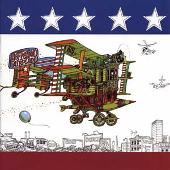
Jefferson Airplane Album: “After Bathing at Baxter's”
| Album Information : |
|---|
| Title: |
After Bathing at Baxter's |
|
|
|
Release Date:1996-01-30
|
|
Type:Unknown
|
|
Genre:Classic Rock, Hard Rock, Oldies
|
|
Label:RCA
|
|
Explicit Lyrics:No
|
|
UPC:078636679822
|
28 of 28 people found the following review helpful:
- Bold as Love
Eric Clapton once opined (in the late 60s: no idea how he would feel today) that groups were either instrumentally oriented (like Cream) or vocally (like the Beach Boys). Jefferson Airplane were the exception that may or may not have proved the rule. No one could deny the vocal chops of Grace Slick and Marty Balin, both wonderful and unique singers, but the instrumental prowess of Jack Casady and Jorma Kaukonen was an equally distinctive and powerful element of the group's sound. To say they offered the best of both worlds is not quite accurate, though: rather they shaped a whole new one.
"Baxter's" was the Airplane at their boldest and most experimental. Released the same year as their commercially successful "Surrealistic Pillow" is was a radical departure from that album. "Pillow" was a tight, conventionally well produced affair, with little bits of psychedelic freak-out thrown in almost as coloration (e.g. the guitar "outro" on "Somebody to Love"). "Baxter's" was unabashed psychedelia, as others have noted below, and was all the more representative of the group's power and their true sensibility.
It's hard to believe that a rock epic like "The Ballad of You & Me & Pooneil" was actually released as a single--let alone the equally adventurous "Watch her Ride," the vocals of which constantly threaten to derail, but never do. Grace Slick's brooding compositions "rejoyce" and "Two Heads" were real stream-of-consciousness dazzlers --"literary", in an unself-conscious way (much less so than the obvious conceit behind "White Rabbit," say) and penetrating. Her subsequent work only occasionally displayed such flashes of true brilliance. (I say this as a fan, but as an honest one.)
The only down side for me (both in '67 and today) was the diminishment in Marty Balin's contribution. Marty's folky romanticism was already losing ground after "Pillow," and he proved to be one of those artists, for whom increased public acclaim and the exhausting demands of touring, actually proved at least temporarily detrimental to his creative output. "Young Girl Sunday Blues" is a real rouser and he contributes lively vocals throughout, but his role in the group was already on the wane. On the group's subsequent releases, he would average two actual lead vocals and share others with Grace and Paul Kantner. Their vocal sparring remained a highlight of the group's later releases (especially the live album "Bless Its Pointed Little Head"). But Kantner was becoming the dominant songwriter by this point, if not the group's actual "leader."
Speaking of Kantner, his writing was still very strong and not nearly as portentous as it would later become. His compositions here, including "Martha" and "Saturday Afternoon/Won't You Try" achieve a splendor here that he would have trouble matching in later years (when everything became an epic). "After Bathing at Baxter's" is experimental rock at its most successful. If it were played for today's audiences, it could be a salvo against the domniant strains.corporate rock--just as it was in '67.
Michael Topper (Pacific Palisades, California United States) - September 24, 2000
10 of 10 people found the following review helpful:
- The Greatest Album Of All Time?
Recorded hot off the heels of their successful "Surrealistic Pillow", which was burning up the charts and one of the main reasons why thousands of teenagers were descending upon the city of San Francisco for the millenium's biggest party, "After Bathing At Baxter's" found the Airplane convinced that they were recording the greatest album of all time. And, in the heady zeitgeist of that era, they just might have. The album was released at Christmas to a puzzled audience; some took to it as the greatest thing they'd ever heard, while the majority of middle-America, irritated at not having another "Somebody To Love", learned just how underground the Airplane really were. If "Takes Off" was the sound of the hippie movement as it was just beginning in '65 and early '66, and "Surrealistic Pillow" a commercially distilled essence of 1966 that became the soundtrack for the summer of love, then "After Bathing At Baxter's" was the summer of love in 1967 as it happened. And what a peak! "Baxter's" takes the sound established on "Pillow" to quantum levels; there are also attempts to bring the band's live playing to focus, as in the bass/drums/guitar duel "Spare Chaynge". The songs are all about freedom, love, abandon and a change of perspective; drummer Spencer Dryden's piece becomes Frank Zappa-ish on "A Small Package", which turns ordinary cocktail-party conversation into a hallucinatory revelation. Slick's two songs "rejoyce" and "Two Heads" are the best of her career, as she plays the crazed intellectual to the hilt, borrowing from "Ulysses" in the former and creating a singularly unique mirror-world in the latter. Everything, from the guitars (this one's mostly electric, although the acoustic "Martha" is a gem) to the harmonies to the drums to the sound effects (many of the guitars, bass, harpsichords, etc are recorded backwards, sped up, slowed down, etc) bristles with a polished sparkle; you can almost taste the acid after "Two Heads" climaxes. After that, the joyous invitation, backed with charged feedback effects and glorious communal four-part harmony vocals, that accompanies "Won't You Try/Saturday Afternoon" is like icing on the cake. 14 of 16 people found the following review helpful:
- How much did/will this change your life?
I used to throw this one on while I was executing psychedelic paintings (tempera paint on poster-board) during sophomore year ('68-'69) at the university.
The first, very long lead guitar note signals the beginning of an epic/epochal journey, which in a way is what this album set out to achieve. It was to be a transformation of the consciousness of our generation, perceived/conceived through what the Airplane offered us through their creativity, experience, and of course their music. It was the herald of a new dawn, a kind of strange bird trumpeting to us of its arrival, and secondarily announcing their new style/sound.
On "The Ballad of You and Me and Pooneil", you almost don't know what Balin and company are singing about, but somehow it makes perfect sense, in a most visionary sort of way. This is excellent, as they don't fall prey to trying to describe the situation too precisely [if you can say/see exactly what it is, you ain't there!] So what you get is the map of the energy currents your soul can follow in order to travel the paths they are marking. Jefferson Airplane are describing and charting the way into and through the region of numinous. (Who really cares whether or not if it's meant to be thought of as drug-induced? It works either way, I'd say).
Dylan never did it any better than this. When Mr. Zimmerman got into a similar mode ["Gates of Eden", "Desolation Row", "The Ballad of Frankie Lee and Judas Priest", et al.), he was busy creating new prophetic religious texts for the New/Now Generation. Bob created a series of alternate worlds staring at us, right in front of us. Or was he semi-transforming what we always see into what we always know, but don't always realize? Again, either way, it works.
Following "Pooneil", there is the relative short interlude of the happy psychedelic party, a sound-space through which meaningful and/or hilarious one-liners, musical passages/quotations and various conversations float, and which segues into the beautiful, very moving "Young Girl Sunday Blues".
Even more amazing is the beginning of the second suite, the song "Martha", during which we succumb to some of the most beautifully poetic lines imaginable, all which compassionately conspire to take us higher and deeper into and through the new vista. "Martha she speaks to me from a feather in the meadow . . . " This is the one song that starts with an acoustic guitar ostinado, which continues throughout. (A little ways in, it's heavily overlaid, in most a friendly manner, by offerings from the lead electric.)
These first couple of suites, Grace is given free rein to use her voice as an accompaniment instrument (Marty does most of the lead singing). Grace was sort of serving the function of a second lead guitar, of course timbrally different. I wonder if Yoko Ono learned how to sing listening to these pieces? Grace does a great job here. Then, later when she takes the lead on the two severely satirical pieces ["Last Wall of the Castle" and "Two Heads"] her voice assumes its usual, masterful [powerful] attitude. These two songs (and to some extent all of 'side two') more or less forecast what's to come next (album #4: 'Crown of Creation'), where satirical and apocalyptic energy/imagery kick in furiously.
Here on 'Baxters' there's not yet too much trouble in paradise . . . Middle America is witnessed as something outside of the new hippie way. Alienation has acted in its own way to create the [beautiful] alternate to what was referred to at the time as the Death Culture. But by splitting humanity/America into two camps, we were led in a way to the partial dissolution of this new vision, as most had our feet planted somewhat in both worlds. 'Crown of Creation' dives headfirst into this fray. Please stay tuned.
Customer review - June 30, 2000
12 of 14 people found the following review helpful:
- Counter Point - A fan who never took acid
Even with all the glowing praise from the other reviewers, I feel compelled to offer to anyone considering this album (or "CD") that, yes, the subject matter might be tied to drugs and SF, but this is simply one of the all-time great albums in all of rock history. I was a senior in high school when this came out, pretty straight, like all my friends who like me went on to be professionals in various areas, and we all completely flipped out over this one album; and not a head amongst us. The points: the best rock bassist ever (Casady) thunders everywhere; high energy driving rock to jazzy piano, bass and drums; the first really effective fuzz effects in rock; lyrics, harmonies, melodies; and most importantly, all the energy of youth busting out everywhere. This album isn't really about drugs, anyway; it's about the culture of the times, great times when rockers were first and foremost musicians making music, not entertainers. So don't let the old hippie reviewers put you off. If you just like rock, this is the best there ever was. 5 of 5 people found the following review helpful:
- Good Psychedelic album from the era
This is an album i have listened to a lot lately, after borrowing it off of somebody. This is a very interesting album, and much better than Surrealistic Pillow by the same artist. And this is a concept album based on the 'stages' one goes through in an acid trip, and the album is arranged into suites to correspond to these stages. From the initial vibrations at the start of the trip: 'The Ballard of you and me and Pooneil' up to the very end with 'Saturday Afternoon'
The music itself is psychedelic (obviously) and features some inspired singing, song-writing and instrumentation. And Jack Cassidy's Bass playing really drives the music forwards... especially on the just over 9 minutes opus 'Spare Chaynge'
Well, I can't give too good a review, as all i want to say about it has already been said. But it's good music and worth a listen, especially if you are interested in music from the same era. Ok, perhaps not quite as spectacular or as psychedelic as 'Electric Ladyland' by Jimi Hendrix (even though that came out a year or two later), or as weird as anything by Captain Beefheart, it'still very good music with nice melodies and damn fine songs! Also, bear in mind that I wasn't around at the time (being 17 now) and that I've never taken acid, my thoughts may not be quite as enthusiastic as someone who was there at the time (if so, i would envy them! )
|